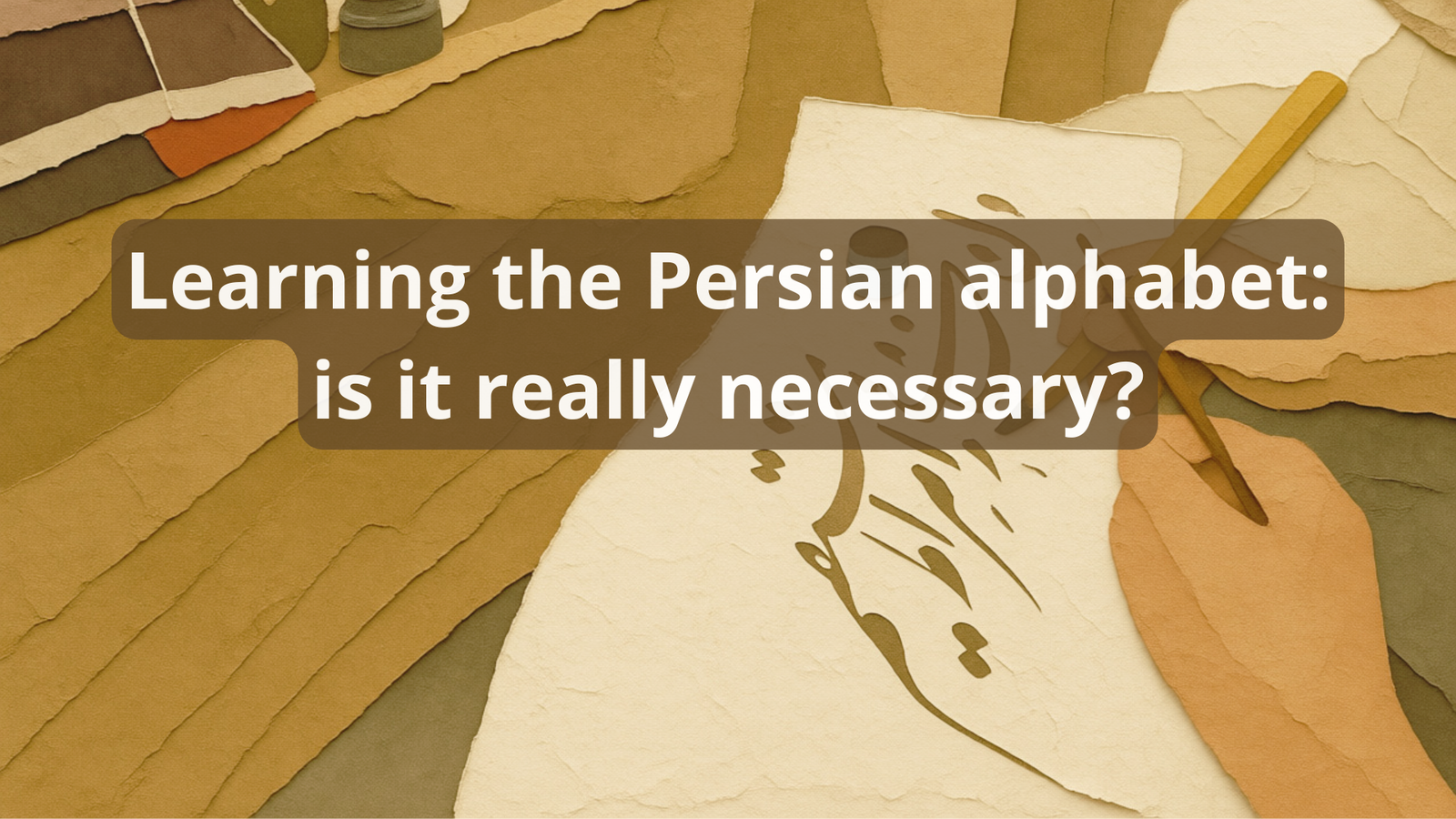
Should you learn the Persian alphabet from the very beginning?
It’s one of the questions I’m asked most often. And my answer might surprise you: not necessarily.
Many people assume they need to master the Persian alphabet before they can start learning the language. In reality, that’s often not the fastest or most effective approach.
To be honest, becoming comfortable with the Persian script takes time. It’s not just a matter of learning around thirty letters. You also have to recognize their different forms depending on where they appear in a word, get used to the fact that short vowels are usually not written, and deal with the Arabic heritage of the writing system: several different letters are pronounced exactly the same in modern Persian. For example, there are several different letters that all represent the sound “z“, even though they are pronounced exactly the same.
As a beginner, that’s a lot to take in at once: learning new vocabulary, remembering pronunciation, understanding grammar, and at the same time becoming familiar with a completely new writing system. For many learners, this can quickly feel overwhelming.
Not learning the alphabet (at first)
For this reason, I don’t usually recommend starting with the alphabet, especially if you’re a complete beginner and you’re not already familiar with either the Persian or Arabic script.
Using phonetic transliteration is a perfectly valid approach. It allows you to focus on what matters most first: understanding, speaking, and gaining confidence in the language. You can build vocabulary, form your first sentences, and train your ear without the writing system becoming an obstacle.
Learning the alphabet (if you want to)
Of course, if one of your goals is to read and write Persian, we can absolutely do that.
In my lessons, I introduce just a few letters at a time, starting with the ones you’ll encounter most frequently. The goal isn’t to rush through the alphabet, but to become familiar with each letter: how it’s written, how it’s pronounced, and how its shape changes depending on its position in a word.
Most importantly, you don’t have to know the entire alphabet before you start reading. With only a few letters, you can already read simple words. Little by little, reading becomes more natural and develops alongside your speaking and listening skills.
In the long run, learning to read and write gives you access to more resources and helps you become more independent as a learner. But there’s no need to rush. We choose the approach—and the timing—that best fits your goals.
Want to go further?
If you’d like to learn Persian in a clear, structured, and engaging way, I offer personalized online lessons adapted to your level and your goals..
📩 Or feel free to contact me directly at farsikhuneh@gmail.com. I’d be happy to help you on your Persian learning journey.